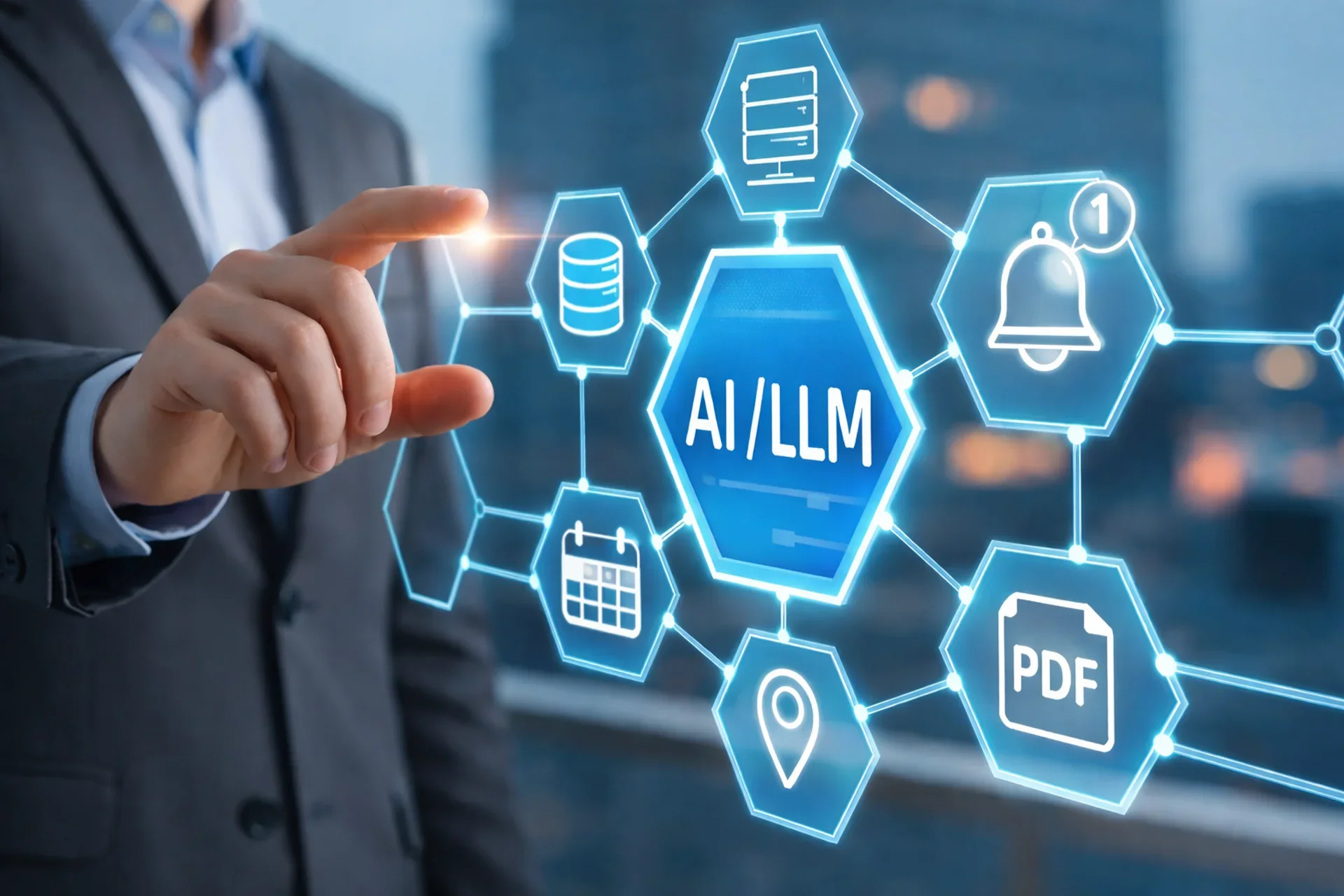
AI Integration
MCP Servers
Most people only know AI through simple chat interfaces like ChatGPT. But with Model Context Protocol servers and tool calling, we empower AI to truly work for your business.
Most people only know AI through simple chat interfaces like ChatGPT. But with Model Context Protocol servers and tool calling, we empower AI to truly work for your business.
Are you still just chatting with AI? While most people experience AI through simple question-and-answer interfaces, the real transformation happens when AI can actually do things – interact with your systems, process orders, book appointments, manage your workflows.
This is where Model Context Protocol (MCP) comes in. Think of it as the USB standard for AI – a universal interface developed by Anthropic that connects AI systems to your tools, data sources, and business processes.
The sky is the limit: Automate customer service inquiries, allow natural language interaction with your webshop, manage inventory through conversation, schedule appointments automatically, generate reports from multiple data sources – MCP makes all of this possible.
From simple to complex tasks – With MCP, AI becomes your tireless employee – handling data entry, generating reports, processing orders, responding to customers, and executing complex multi-step workflows automatically. While you focus on strategy, AI handles the repetitive work.
MCP is an open protocol from Anthropic that's becoming the de facto standard for AI integrations. Write once, use everywhere.
Your employees and customers can interact with your systems through natural conversation instead of clicking through complex menus.
Hundreds of MCP servers are already available as open source – from Google Drive to GitHub to databases. And for your specific APIs or internal systems, you can easily develop custom MCP servers.
MCP servers are already transforming how businesses operate. Here are some powerful examples of what's possible today:

In the US, AI voice assistants show how much phone reservations can be automated. In a case study of the restaurant group DineAmic Hospitality (OpenTable Voice AI), they reported 70% automated call resolution, 31% more incremental bookings, 725+ hours saved, and 98% satisfaction.

Imagine your customers could shop naturally: "I need 2 bags of premium coffee beans delivered by Friday." The AI checks inventory, confirms the delivery date, processes the order, and responds: "Perfect! Your coffee will arrive Thursday afternoon."
Behind the scenes, MCP servers connect to your inventory system, payment gateway, and logistics platform – all through one conversation.

Connect AI to your CRM, accounting software, project management tools, and databases. An AI assistant can now answer questions like: "Show me all overdue invoices from Q4" or "Create a new project for client X with the usual team setup."
MCP servers already exist for systems like Slack, Google Drive, GitHub, Postgres databases, and many more – with new ones being added constantly.
MCP servers enable two complementary approaches to AI automation – each with its own strengths:
Ihre Mitarbeiter oder Kunden interagieren direkt mit einem KI-Assistenten durch natürliche Konversation, genau wie ChatGPT – aber mit echten Fähigkeiten.
Using workflow automation platforms like n8n, AI agents can run autonomously in the background – monitoring systems, reacting to events, and executing complex workflows without human intervention.
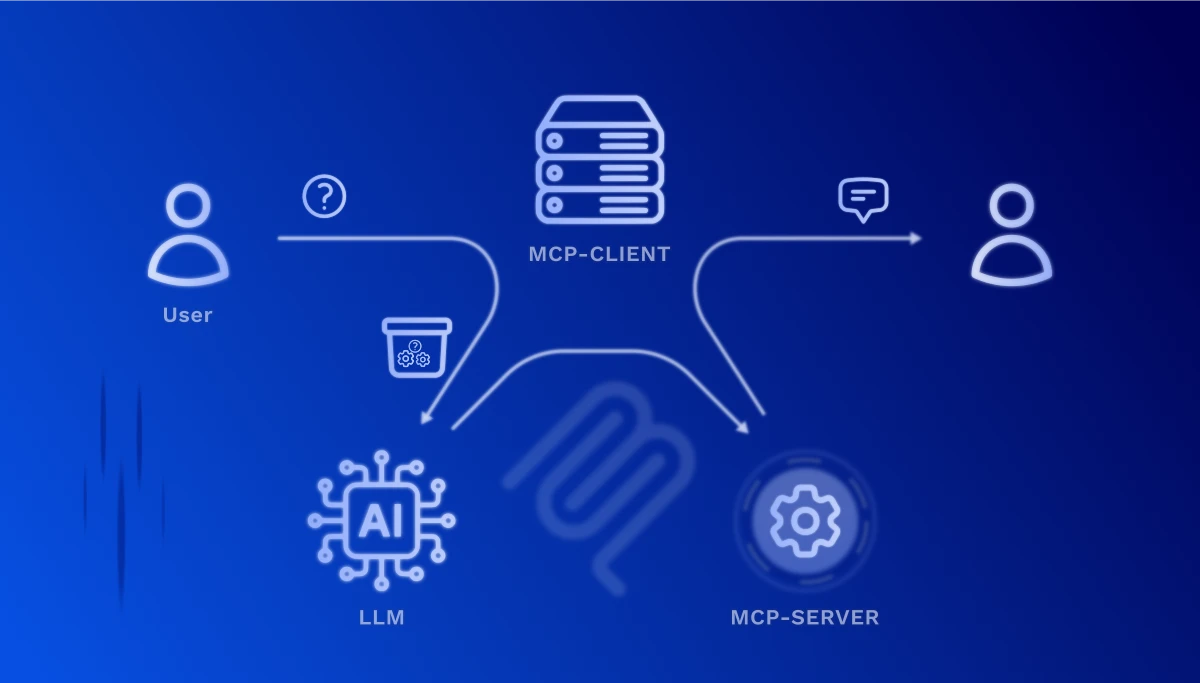
An MCP client (e.g., a chat app or IDE) sends your request to the LLM together with the available tools. If the model decides to use a tool, the client forwards the tool call to the appropriate MCP server, which executes the action in your systems and returns the result. That result is provided back to the LLM – which then formulates the final response for you.
Model Context Protocol (MCP) was open-sourced by Anthropic in November 2024 as an industry standard for connecting AI systems to external data and tools.
Think of MCP as USB-C for AI – before USB, every device needed its own proprietary connector. Now, one standard works everywhere. Similarly, MCP eliminates the need for custom integrations for every AI tool and data source combination.
The ecosystem is growing rapidly: Major development platforms like Zed, Replit, Codeium, and Sourcegraph have integrated MCP. Companies like Block and Apollo are early adopters. Pre-built MCP servers exist for Google Drive, Slack, GitHub, Postgres, Google Maps, calendar systems, PDF generation, and many more – with the community adding new servers weekly.
The open-source community has already developed hundreds of MCP servers that you can use directly. Even more important: for any API, web service, or internal system, you can write custom MCP servers – the protocol is open and well-documented. This makes MCP the universal bridge between AI and virtually any digital resource in your organization.
For businesses, this means: Reduced development time and costs, future-proof integrations, access to a growing ecosystem of ready-made connectors, and the flexibility to build custom MCP servers for your proprietary systems.
MCP servers connect AI directly to your systems – a powerful capability that requires careful security implementation. New integration points also mean new potential vulnerabilities.
Not all MCP servers are equal. Open-source packages can be powerful but also carry risks: outdated code, hidden vulnerabilities, or inadequate maintenance. Choosing trustworthy servers is critical.
A powerful AI agent with unrestricted system access can cause significant damage – whether through errors or malicious manipulation. Clear boundaries and permissions are essential.

Let's explore how MCP servers can automate your processes, enhance customer experiences, and unlock new possibilities for your business.
Get in touch